

Chapter 1. The Basics of the Enneagram
The innocent mistake that keeps us caught in our own particular style of ignorance, unkindness, and shut-downness is that we are never encouraged to see clearly what is, with gentleness.
—Pema Chödrön, The Wisdom of No Escape
The Enneagram is a system that describes the nine fundamental types of personality. “Ennea” means nine, and “gram” means model or type; hence, the nine types of personality.
The triangle inside the circle has been a cornerstone of the Alcoholics Anonymous symbol for fifty or more years. The AA symbol represents the three sides of recovery—recovery, unity, service—while the triangle within the Enneagram represents the three sides of the human being: the body (sensing), the heart (feelings), and the head (thinking).
The circle represents full consciousness. When an individual becomes conscious in all three centers of intelligence, he becomes a fully conscious human being, present, awake, healthy, internally and externally unified, and in harmony with himself and life. He is not pulled in dozens of directions but is in a state of unity within himself. He knows himself and is at ease within himself—the very goal of addiction recovery. He is happy, joyous, free, serene, and able to navigate life optimally.
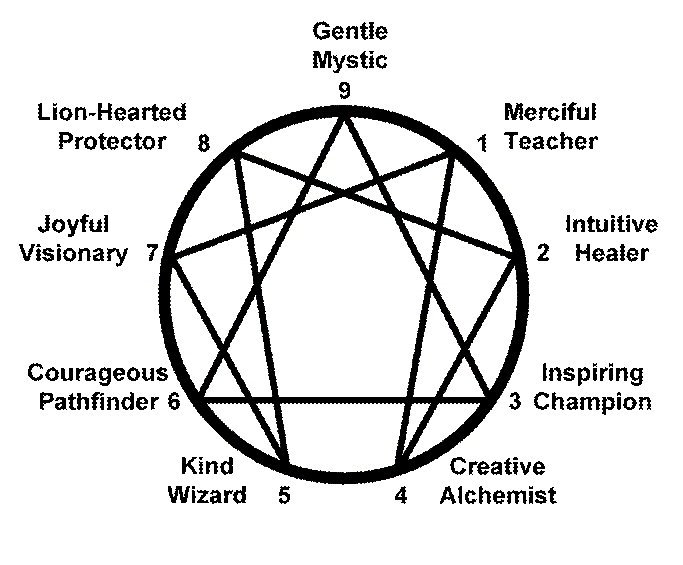
<CAPTION>Figure 1. The Enneagram
The hexad is the symbol for change. This is the six-sided figure that runs from 1 to 7 to 5 to 8 to 2 to 4 to 1 inside the circle. It symbolizes the reality that nothing is static, that everything is in a state of change, be it evolving or disintegrating. If a human being becomes conscious, he begins to evolve, expand, and experience reality on deeper and more satisfying levels. If he remains unconscious, then he moves in the direction of negativity and addiction. As is said in recovery circles, “You either grow or you go,” meaning one is either evolving and expanding his awareness or inevitably preparing for a relapse back into unhappiness and addiction.
The Enneagram is a tool for assisting individuals to become conscious, aware, and joyfully engaged with themselves and their loved ones. It is a map out of the darkness of addiction and into the realm of freedom, well-being, and the capacity to create deep emotional bonds and generously share one’s capacities with others.
The Enneagram symbol and its origins are unknown, but through a remarkable adventure, a man named Georges Gurdjieff discovered the symbol at a monastery hidden in the hills of Afghanistan in the early 1900s. Through Gurdjieff, the symbol eventually made its way from Russia to America in 1915. (To get a glimpse of this remarkable journey, read In Search of the Miraculous by P. D. Ouspensky, or Meetings with Remarkable Men by Gurdjieff.) It was in the 1950s that Oscar Ichazo associated the nine points of the Enneagram symbol with nine different personality types, and then through the pioneering work of Don Riso (beginning in 1970) that the depth of the types was mapped out.
Riso, through intense research, created a model that mapped out nine levels of development (or “levels of presence”) in each type, divided into three sections: healthy, average, and unhealthy. (Riso’s treatise on this phenomenon is found in the book Personality Types. See Resources for more on the Enneagram and addiction.). These levels are critical for understanding addiction, the particular way it manifests in each type, and the specific challenges that each type faces in the journey to recovery and discovery of the true self.
Don Riso and Russ Hudson created a model of the psychic structure of the types, identifying the psychological paradigm that each type lives in and struggles with. The more unconscious an individual is as a result of trauma and addiction, the more he is imprisoned and blinded by the restrictive and compulsive defense mechanisms germane to his type. He has less freedom to objectively experience reality, to consciously choose his response, or to choose among possible alternatives. In addition, the more unconscious and constricted an individual is, the less likely he will respond with clarity and alertness or have the capacity to draw upon his innate gifts to navigate and celebrate life. His defensive reactions will limit his ability to engage with, enjoy, and trust people or to navigate life with grace, dignity, and confidence.
The Enneagram is designed to open the doors to an individual’s freedom such that one’s genuine self can arise and no longer be shrouded in misery. Knowledge of the psychic structure of one’s type is critical for making this heroic journey through addiction and for releasing the defensive structures one has acquired due to one’s history.
The Psychic Structure of the Personality
The internal psychic structure of each type consists of the following:
The essential, or healthy, qualities of the type represents the innate gifts and qualities of authentic being that an individual is born with. When an individual is forced to disengage and close down his true qualities due to an environment that cannot support him, a basic fear arises in response to this soul shock. This basic fear represents the tremendous terror that ensues when contact with one’s genuine qualities and real self is lost. The small child goes into a freak-out that Riso-Hudson call the “primal catastrophe.” The more one is disconnected from his true essence and innate gifts, the more he experiences this fear, and the more rigid, defensive, and contracted he becomes in response to the loss.
In response to the basic fear, a basic desire, a deep wish, arises that reflects an individual’s wish to manifest and reconnect to the inherent gifts of his type, to the innate gifts that he loves deeply and wishes to be in contact with.
The passion, or emotional habit, of the type reflects the emotional reaction and constriction one experiences when losing contact with one’s true nature. When an individual’s heart shuts down, be it from life trauma, addiction, inattention, or cultural constraints, then the particular emotional habit of the type is activated in service of self-protection from a broken heart.
The fixation, or mental habit, of the type works in concert with the passion to support the individual’s disengagement from reality, thus inhibiting his capacity to know and sense what is real. Depending on how strongly the individual is under the power of his type-specific fixation and passion, he will be more or less unconscious and unable to clearly observe himself and the suffering he is causing himself and others. Addiction and substance abuse intensify the emotional passion and mental fixation of the individual, sending him into more reactive, impulsive, and constricted behavior, thereby increasing his suffering and his tendency to be driven deeper into addiction.
The inner critic represents the type-specific messages that an individual has learned to criticize and abandon himself, shutting down his true feelings, thoughts, and aliveness in order to be safe and avoid attacks from the environment. The inner critic and its soul-inhibiting messages develop in a child in reaction to the many “shoulds,” expectations, rules, and judgments communicated to him through his parents, friends, caregivers, culture, school, teachers, and other sources. These shape his inner critic messages, which play like an audiotape through his mind.
When a child learns that he cannot safely express anger, joy, fear, enthusiasm, love, tenderness, honesty, and other qualities, he develops a type-specific inner critic message that supports the inhibition of what is real and true within him. He learns to act in a certain manner, shapeshifting to please or adapt to his caregiver’s or culture’s demands. The inner critic messages support the automatic operation of the fixation and passion of his type and serve to discourage his expansion, optimization, and free-flowing creativity. Initially developed to endure and numb the suffering of childhood, the inner critic mechanism is a prime source of unhappiness and addiction in adulthood, and keeps the individual locked in his Enneagram patterns.
The self-image consists of each type’s identification with his innate capacities. For instance, Type Four draws on his sensitivity and creativity to develop an identity. When healthy, the Four’s self-image reflects who he truly is. The Four says, “I am sensitive, creative, passionate, emotionally real, intuitive, and attuned to the depth and beauty of reality.” His actions reflect his self-image. As the Type Four (or any type) loses contact with what is real and true within him, he continues to believe he is manifesting the healthy qualities of his self-image while his behaviors begin to move in a less healthy directions. The more unhealthy he becomes, the more his actual behaviors reflect the opposite of his innate gifts. For example, the less healthy Type Four treats individuals with insensitivity but imagines himself as sensitive. This distortion magnifies when addiction sets in, further diminishing his self-awareness.
These are the fundamental psychic structure building blocks of the individual’s personality type. They are described in great detail in each chapter on the types.
The Types in Recovery
Each of us has inherited a particular personality type, or temperament, with which we navigate life. This is the lens through which we interpret, receive, and experience reality. When healthy, we express the positive qualities of our type in our own unique manner, while the negative manifestations are only mildly problematic. Keep in mind that we all have all of the type patterns available to us because they represent what is universally human, but we each have one central type pattern that is dominant and takes our attention most frequently.
When we are not healthy, our negative manifestations hold sway and we are often run by our defensive emotional and mental habits, which operate automatically and beyond our conscious control and insight. We take actions without our permission (similar to the alcoholic who realizes that he drinks without his permission). We act without real choice or real awareness; that is, we react rather than act,as with drinking and drugging addictions. When we are less healthy, we can’t observe ourselves clearly or accurately, don’t have eyes to see what triggers us and moves us into action, can’t consciously see when our buttons have been pushed, and can’t perceive with accuracy how our behavior affects others or ourselves. And yet, we think we understand reality, think we are interpreting correctly.
The bottom line is that we become sincerely deluded such that it appears that our problems are generated by othersin our lives (unless we are one of the types that habitually blame themselves for everything). If they would just get healthier, act kinder, be more compassionate, then my life would be good!
Our individual type indicates a spectrum of positive and negative qualities and attributes with which we are endowed. It describes how we can positively embrace reality or leave reality and abandon ourselves and our gifts through our type-specific, unconscious habits.
The Enneagram is an extremely useful tool with which to approach addiction treatment. It will help the therapist, counselor, and sponsor more specifically address the unique characteristics each individual type exhibits in addiction. It provides a map of hope, clarity, and understanding for compassionately guiding the recovering person.